


The forms, documents and rules for moving household goods between Canada and the U.S., in both directions, in one place.



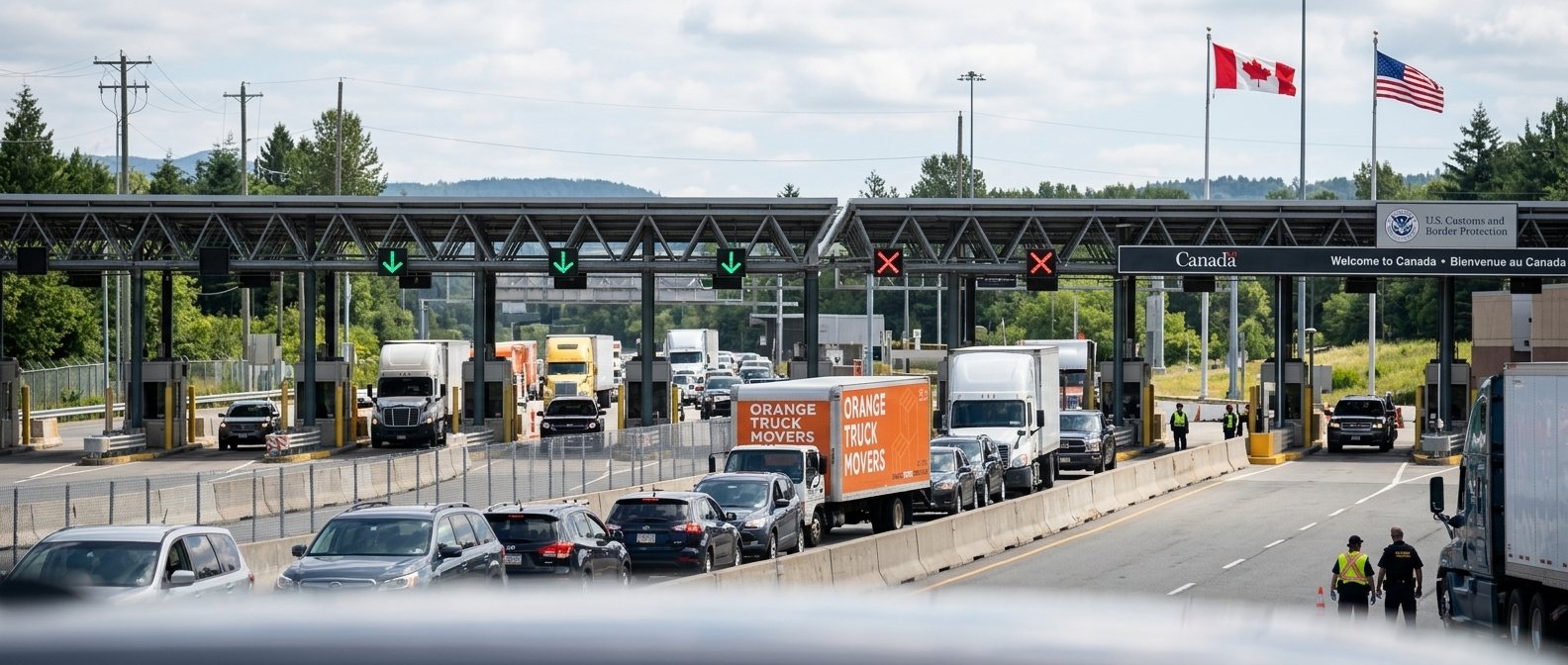
Every household move between Canada and the U.S. goes through a standard customs inspection at the border. An officer checks your paperwork against your inventory, then releases the truck to continue to your new home.
Used household goods and personal effects generally cross free of duty in both directions. What changes by direction is the paperwork: Canada accepts digital forms, while the U.S. requires an original, signed form.
10+
Years Guiding Customers Through Customs
400+
Cross-Border Moves a Year
4
Border Crossings We Use
0
Customs Brokers Needed in Most Moves
The truck stops at the crossing for a standard inspection. Our crew presents your paperwork and shipment, and the officer checks your documents against your inventory. In most cases you do not need to be there, and clearance takes anywhere from under an hour to several hours depending on how busy the crossing is.
U.S. to Canada
Canada Border Services Agency (CBSA) inspects the shipment. Your goods list is declared on the Personal Effects Accounting Document, and Canada accepts digital copies. If you arrive before your belongings, you declare a goods to follow list when you first enter Canada.
Canadian forms and documents
Canada to the U.S.
U.S. Customs and Border Protection (CBP) inspects the shipment. Household goods are declared on CBP Form 3299, and CBP requires the original with your handwritten signature, so we collect it from you before moving day.
U.S. forms and documents
Peace BridgeBuffalo, NY and Fort Erie, ON
Lewiston BridgeLewiston, NY and Queenston, ON
Thousand Islands BridgeAlexandria Bay, NY and Lansdowne, ON
Champlain and LacolleChamplain, NY and Lacolle, QC
Pacific HighwayBlaine, WA and Surrey, BC
You build a detailed inventory and we tell you which forms you need, then review them with you.
The truck joins the commercial lane and our crew presents your paperwork and shipment to the border officer.
The officer verifies your paperwork against your inventory. Clearance usually takes anywhere from under an hour to several hours.
Once released, the same crew continues to your new home and unloads.
Bring every document that applies to your move. Links open the official government forms.
Form or document
What it is for
Who completes it
Personal Effects Accounting Document. Lists the household goods and personal effects you bring into Canada.
You, with our help
Goods to follow list. Covers belongings that arrive after you. Declare it the first time you enter Canada and keep the stamped copy.
You, with our help
Passport
Proof of identity at the border. Canadian citizens show a Canadian passport.
You
Immigration documents
Work permit, study permit or permanent residence confirmation from Immigration, Refugees and Citizenship Canada (IRCC), for non-Canadians.
You
Detailed inventory
Every item described specifically, with serial numbers on valuables. We write it for you with full packing.
You, or us with full packing
Form or document
What it is for
Who completes it
Declaration for Free Entry of Unaccompanied Articles. Declares your household goods for duty-free entry. Must be the original, signed copy.
You, with our help
Passport and visa or green card
Proof of identity and your right to live in the U.S.
You
Detailed inventory
A complete list of what is on the truck, matched against Form 3299 at the border.
You, or us with full packing
Generally, no. Used household goods and personal effects cross free of duty in both directions, as long as you meet the ownership rules for your situation.
Goods you owned, possessed and used before moving enter free of duty and tax as settlers’ effects. If you sell or give them away within a year, duty becomes due.
After a year or more abroad, goods you owned for at least six months qualify. Any single item worth more than CAN$10,000 is taxed on the amount above that.
Household goods used abroad for at least a year can enter duty free when declared on CBP Form 3299. Goods for sale or for someone else do not qualify.
Brand new items still in packaging and goods used for business can be charged duty. Flag them on your inventory so nothing surprises you at the border.
We share a full prohibited items list once your move is booked, and we work with you to find a solution for anything on it. These are the items customers ask about most.
Item
On the truck?
What to know
Used mattresses
Yes
Allowed into Canada as part of a household move, with no fumigation. We have moved hundreds.
Food
No
No food of any kind on the truck. You can bring small quantities in your own vehicle.
Alcohol and tobacco
No
Not on the truck. Small personal amounts can travel in your vehicle within each country’s limits.
Live plants
With permits
Permitted with extra paperwork and permits, so many customers leave them behind.
Firearms
No
Firearms cannot travel on our trucks. Transport them separately and declare them at the border yourself, following each country’s licensing rules.
Vehicles
Yes
We have moved cars across the border dozens of times. Vehicles need their own import and export paperwork, so tell us early and we will walk you through it.
Most delays come from the paperwork, not the border. These are the mistakes we see most often.

U.S. to Canada
“They were super knowledgeable about the customs process and made everything very easy.”
D. S., Google review
Read More ReviewsThe customs questions we hear most. More answers on moving across the border are in the Cross-Border FAQ.
Cross-Border FAQ
No. Orange Truck is not a customs broker, but in most cases our crew handles clearance on your behalf, so you do not need to hire one.
Usually anywhere from under an hour to several hours, depending on how busy the crossing is.
Yes. We tell you which forms you need, help you fill them in and review them before moving day.
Generally, no, though there are exceptions. Call us and we will look at your situation.
Not on the moving truck. Small quantities of food, alcohol and tobacco can travel in your own vehicle. Live plants need extra permits, so many customers leave them behind.